EHCP
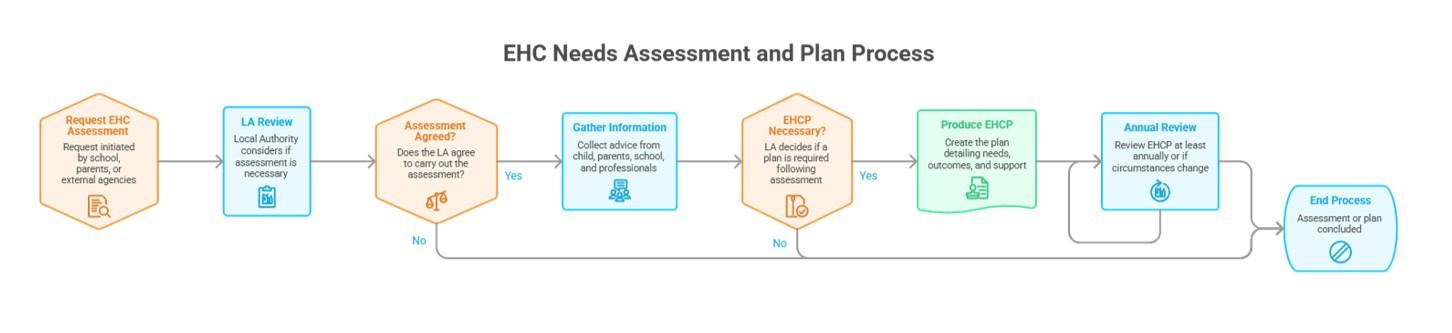
If a child or young person continues to experience significant difficulties despite receiving high-quality, targeted support through the school’s SEN Graduated Approach and appropriate interventions, the school may consider requesting an Education, Health and Care (EHC) needs assessment. The child or young person and their parents or carers should be involved throughout this process, with their views, wishes and feelings taken into account.
Parents or carers can also request an EHC needs assessment directly from the Local Authority (LA). Other professionals and agencies can also bring a child or young person who has, or may have, SEN to the attention of the Local Authority where they believe an EHC needs assessment may be necessary.
An EHC needs assessment may be considered when a child or young person has, or may have, special educational needs and it may be necessary for the LA to determine what special educational provision is required. This may be particularly relevant where the child’s needs are complex or significant and the provision normally available through SEN Support is not sufficient to meet their needs.
Having a diagnosis, such as Autism Spectrum Disorder (ASD), ADHD or dyslexia, does not automatically mean that a child or young person requires an EHCP. The decision is based on their individual special educational needs and whether an EHC plan is necessary to meet those needs. Local Authorities may also provide local guidance about their EHC needs assessment processes.
When a Local Authority receives a request for an EHC needs assessment, it must decide whether an assessment is necessary. This decision will take account of information about the child or young person’s special educational needs, their progress, the support and interventions already provided, and any relevant advice or evidence from professionals. The child or young person’s views, wishes and feelings, and those of their parents or carers, should also be considered.
The Local Authority should normally notify the parent or young person within six weeks of receiving the request whether it will carry out an EHC needs assessment. If an assessment is agreed, further information and advice will be gathered from the child or young person, their parents or carers, the school or educational setting, and relevant education, health and social care professionals.
These contributions help to build a full picture of the child or young person’s strengths, interests, views, wishes, aspirations and outcomes, as well as the barriers and difficulties they experience. The assessment should consider what special educational provision may be required to meet their identified needs and help them achieve their outcomes.
Following the assessment, the Local Authority will decide whether an EHC plan is necessary. If an EHC plan is agreed, the Local Authority will produce the plan. The plan will set out the child or young person’s special educational needs, the outcomes they are working towards, and the special educational provision required to support them in achieving these outcomes. Where relevant, it will also include their health and social care needs and provision.
The EHC needs assessment and plan should normally be completed within 20 weeks of the Local Authority receiving the request for an assessment.
EHCPs must be reviewed at least once every 12 months. A review may also take place earlier if there is a significant change in the child or young person’s circumstances or needs.
For further information and guidance, please visit the East Riding Local Offer.